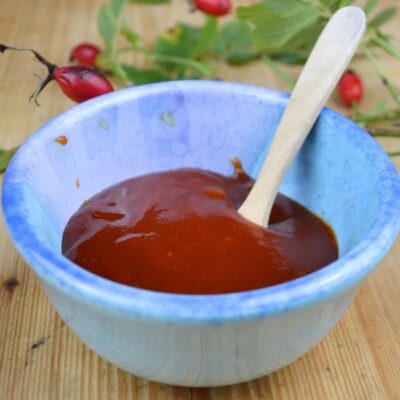
How to Make Rosehip Jam: Step-by-Step Recipe
Discover how to make homemade rosehip jam with this step-by-step recipe. Although preparing the rosehips takes a little time, the result is a delicious, fruity jam that captures the flavours of autumn. A rewarding way to use freshly gathered rosehips and enjoy a homemade preserve throughout the colder months.
Equipment
- food mill
- thin colander
- cheesecloth or similar.
- A medium saucepan
- A large saucepan
- Wooden spoon
- A small cool plate
- Sterilised jam jars
Ingredients
- 1 kg of Fresh rosehips
- Water to cook the rosehips
- 800 grams of Sugar
- 1/2 Lemon juice
Instructions
- Harvest and preparation:
- When picking rosehips, look for fruit that is bright red and ripe, not green or shrivelled.
- Clean the rosehips by cutting off the ends and stems with a knife, and discard any bad fruit.
- Put the rosehips in a big saucepan.
- Wash the fruit, then fill the saucepan with water to cover it.
- Cook for at least 1 hour, until the fruit is very soft.
- Try a fork or spoon against the side of the saucepan to check if they are soft; if they are hard, cook them a bit longer.
- Processing the fruit:
- If you are using a food mill, pass the fruit through the larger holes twice and the smaller holes once.
- Now the hard work begins! If you're using one, prepare the food mill.
- Add a small amount of the fruit at a time; it is easier to work with smaller batches.
- Once you've finished passing all the fruit, put the leftovers (the seeds and peels) in a saucepan with some water and cook them. This helps you extract as much juice as possible.
- Pass it through the food mill again. After this, you can discard the seeds into the compost.
- Pass the rosehip pulp through the smaller sifter in the food mill.
- And then pass the rosehip pulp a third time! Through a thin sieve.
- After you pass the rosehip pulp through the sieve, pass the fruit through a cheesecloth or something similar to remove the rosehip's tiny needles.
- Once you finish the long process of turning the fruit into a smooth rosehip pulp, weigh it to calculate the sugar you need.
- For every kilo of rosehip pulp, I add about 800 grams of sugar and the juice of half a lemon.
- Cook and jar the jam:
- Mix the rosehip pulp, sugar and lemon juice in a large pot, and bring to a boil. Stir constantly until the sugar is completely dissolved.
- Reduce the heat to a simmer for about 1,30 to 2 hours, stirring to prevent burning.
- While the jam cooks, sterilise the jars you'll use. I sterilise them by rinsing them and putting them in a low oven for at least 10 minutes, or you can also boil the jars for 10 minutes.
- I always prepare more jars than I need. For every kilo of fruit, I will use 4 or 5 350 g jam jars.
- How to test if the jam is ready
- Once it thickens, check if it is ready by pouring a spoonful of jam onto a cool saucer; if you run a finger through the puddle and it doesn't join together, it is ready.
- Once ready, sterilise your jars, then jar the rosehip jam while it is hot and seal them.
- After days of hard work, relax and enjoy your delicious homemade rosehip jam!
Notes
Use ripe rosehips.
Cook them until very soft.
Don't skip the straining stage.
A food mill makes the process much easier.
Use a wide saucepan for the final cooking.
Stir regularly.
Be patient—the process takes time!
Make sure your jars are properly sterilised.
How to store rosehip jam Store the jam jars in a dark, cool place. Once open, keep in the fridge.
How to store rosehip jam Store the jam jars in a dark, cool place. Once open, keep in the fridge.