Easy, healthy, homemade bread recipe to make with kids

This simple bread recipe is perfect for baking with kids.
You can add raisins, nuts, seeds, chocolate chips, cinnamon or mixed spice to your breads.
This recipe is enough to make one large loaf, two medium loaves, four small loaves or make 12 mini ball breads.
Equipment
- 1 small bowl
- 1 large Bowl
- 1 small saucepan
- 1 measuring cups and spoons
Ingredients
- 450 grams or 3 cups) of white bread flour
- 150 grams or 1 cup of whole wheat flour.
- 325 ml or 1 1/2 cups of warm milk
- 1 tablespoon of dry yeast
- 3 tbls of brown or raw sugar
- 2 tablespoons of soft butter
- Raisins, cinnamon, nuts, seeds, or chocolate chips. (Optional)
Instructions
- Warm the milk.
- Test the milk with your fingertip; it should feel comfortably warm—just above body temperature, but not so hot that you need to pull out your finger immediately.
- Place the warm milk in a bowl with one tablespoon of sugar and the yeast.
- Mix them, cover with a wet cloth, a beeswax wrap, or plastic wrap, and leave in a warm spot for about 10-15 minutes, until bubbly.
- You'll notice the surface becoming foamy or forming bubbles—this shows the yeast is alive and working.
- While you wait for the yeast to be ready, in a large mixing bowl, combine the flour, salt, and the remaining sugar.
- Add the soft butter. Using your hands, combine the butter into the dry ingredients until the mixture resembles sand.
- When the yeast is ready, make a hole in the middle of the flour mixture and add the yeast.
- Using your hands or a spoon, start mixing in a spiral from the centre of the hole, gradually expanding to the sides of the bowl to incorporate the dry ingredients
- When you have a dough, knead the dough. The kneading process takes about 15 minutes by hand. You can use a stand mixer. However, when baking with children, I always prefer to do everything by hand, and you can always take turns with your children kneading the dough.
- Leave the dough to rise at room temperature in a warm place for about 45 minutes to an hour, until it has doubled in size.
- When the bread dough has doubled in size, it is ready to shape.
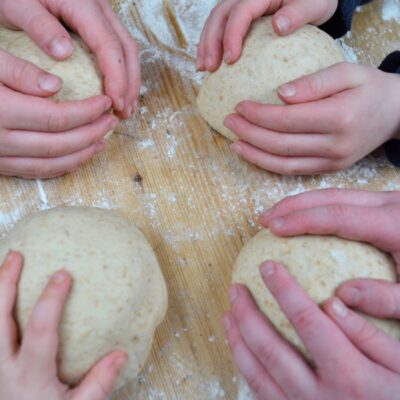
- Work on a floured surface. If you are making small loaves for each child, cut the dough into smaller portions and form a ball for each child.
- And let the children get creative and work with the dough to make their own breads.
- Let it rise a second time while the oven heats.
- Bake for 20-25 minutes.
- Take the bread out and cool on a wire rack
Notes
You can use different flours, like spelt, for this recipe.
As long as you use 600 grams of flour, you can also change the proportions. You can make it with 2 cups of white flour and 2 cups of whole wheat flour, or use three different flours, such as rye, whole wheat, and white flour.